






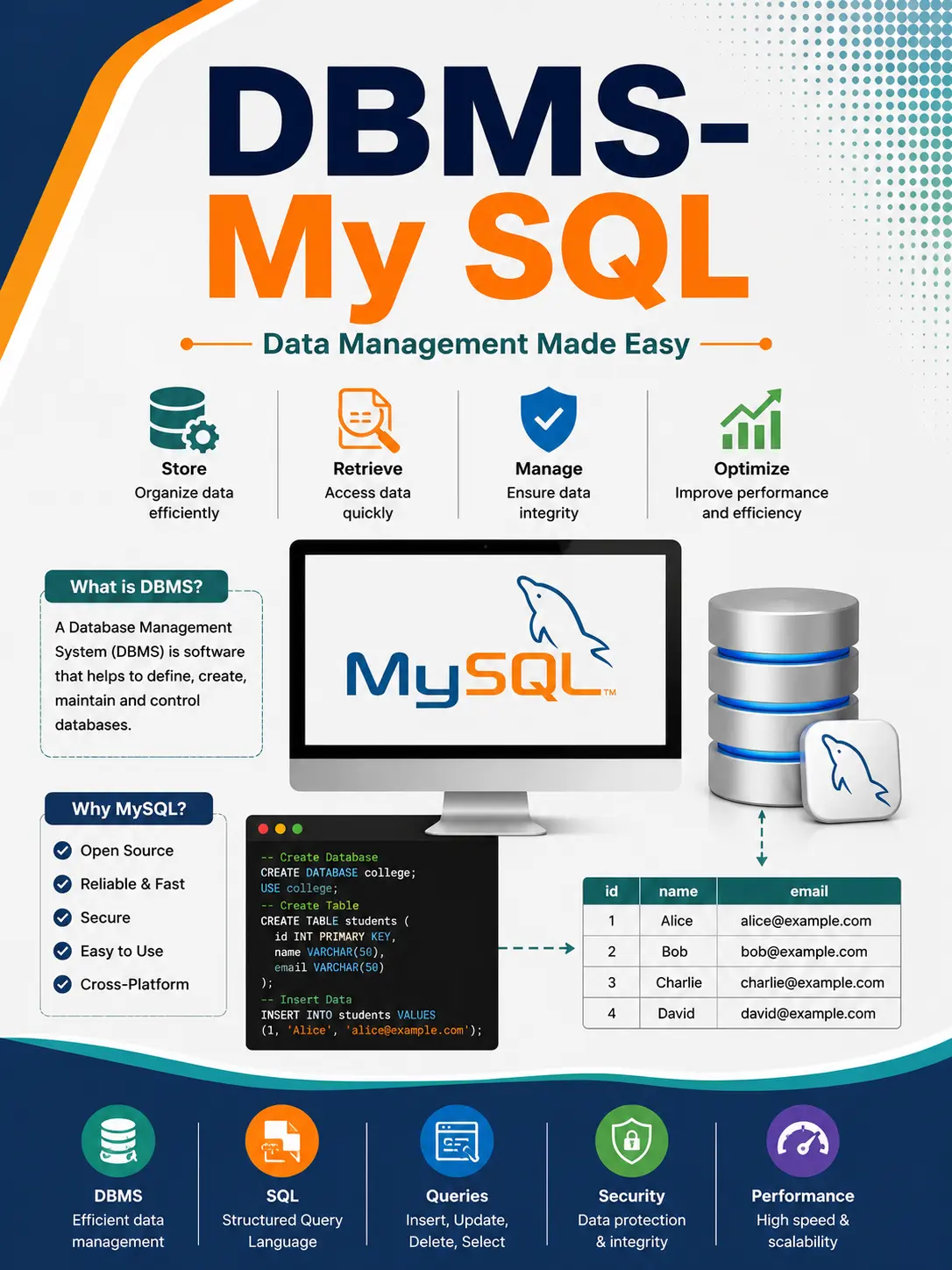
DBMS (Database Management System)
1. Introduction
-
DBMS stands for Database Management System.
-
It is used to store, manage, and retrieve data efficiently.
-
Example: MySQL, Oracle, SQL Server, MS Access, PostgreSQL.
2. Database
-
A database is a collection of related data.
-
It stores data in an organized form (tables).
-
Example: A school database may have tables for students, teachers, and subjects.
3. Table
-
Data is stored in rows and columns format.
-
Each row represents a record.
-
Each column represents a field (attribute).
| Sr. No. | Name | Mobile No. | Date of Joining |
| 1001 | Ankit Sisodia | 821892***** | 2025-10-** |
| 1002 | Ramesh Kumar | 905889***** | 2025-05-** |
4. Advantages of DBMS (Database Management System)-
-
Data Redundancy Control –
DBMS avoids storing the same data multiple times by centralizing it. -
Data Consistency –
Because data is stored in one place, any change is reflected everywhere, keeping data accurate. -
Data Sharing –
Multiple users and applications can access the same data simultaneously. -
Data Security –
Access to data can be controlled using authentication and authorization features. -
Backup and Recovery –
DBMS automatically takes care of data backup and recovery in case of failure. -
Data Integrity –
Ensures accuracy and correctness of data using integrity constraints (like primary key, foreign key). -
Efficient Data Access –
Provides fast and efficient data retrieval using query optimization. -
Multiple User Interface –
Supports different interfaces (forms, queries, reports) for various users. -
Reduced Application Development Time –
Common data handling tasks (searching, sorting, etc.) are managed by DBMS, reducing programming effort. -
Concurrency Control –
Allows many users to access data at the same time without conflicts. -
Data Independence –
Data structure changes do not affect the application program directly. -
Improved Decision Making –
Provides accurate and timely data for better analysis and business decisions